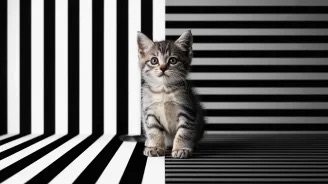
A True Scientific Study That Reveals We Only See the World We Were Trained to See
A story from around 1970 still stands today as one of the most profound psychological truths ever discovered. It isn’t a tale created by a motivational speaker or borrowed from a self-help book. It is a real event that unfolded inside a scientific laboratory. The experiment was conducted on tiny newborn kittens, all in search of one question: How does the brain truly understand the world?
In a groundbreaking study conducted in the 1960s, scientists created two groups of kittens. Both groups consisted of freshly born babies whose minds were still untouched shapes of raw potential. After birth, the kittens were kept in complete darkness. Only for a few hours each day were they brought outside, and even then they were not shown the real world.
The first group saw only vertical lines.
Walls, ceilings, floors — everything around them was made of tall, straight, upright lines.
The second group lived in the exact opposite world.
They were shown only horizontal lines — broad, flat, stretched-out patterns that filled their entire field of vision.
Both environments were artificial, but for those innocent newborns, that fabricated world became the only world they knew.
To them, it was not an illusion.
It was reality.
The experiment continued for many days. Slowly, their eyes opened. Their brains developed. The map of the world began forming inside them. And that map reflected only what they saw every day — one brain shaped for a vertical world, the other for a horizontal one.
Weeks later, the scientists released both groups into a real, normal environment for the very first time. This was the true test. As soon as the kittens tried to explore the room — the table, the chairs, the doors, the patterns of everyday life — something astonishing happened.
The kittens raised in horizontal-only environments simply could not perceive vertical objects.
A table leg right in front of them was invisible to their minds. They would walk straight into it because their brains had never learned what “vertical” meant.
And the kittens raised in vertical-only worlds were just as blind to horizontal forms. Flat surfaces, wide edges, level planes — these things did not exist for them. Their brains had no neurons to interpret those shapes.
What they had never seen in childhood, their brain had never learned to understand.
By the end of the experiment, scientists were forced to confront a truth that changed the direction of psychology forever.
The biological brain is not born fully prepared.
It is sculpted by experience.
It learns to understand whatever it is shown, and it develops no ability for what it has never been exposed to.
Humans are no different. We see the world according to the habits, beliefs, and conditioning we absorb in childhood. The ideas planted deeply in our early years become the lens through which we view everything that follows. They define where we notice opportunities, where we sense danger, which dreams appear possible, and which boundaries hold us back.
What the mind is trained to believe from childhood becomes its truth.
That is what we see.
That is what we seek.
And that is what we live.
This story is not only about kittens.
It is a mirror held up to our own minds.
The world has always been vast, but we notice only the part we were taught to notice. Very few people ever break this early conditioning, and even fewer dare to think outside the box.
This is the essence of the 1960 Classical Blakemore & Cooper Study, and it continues to be taught in neuroscience lecture halls around the world today.